Celebrating 20 Years of Queer Media & Pop Culture!
Celebrating 20 Years of Queer Media & Pop Culture!

@balzertalk

Money, but make it real: who gets to decide?
By now, we've talked about saving money. We've talked about spending it. We've talked about the mental gymnastics that come with finally using the money you've spent a lifetime accumulating.
But there's another question I didn't expect to spend much time thinking about when I started talking to Darla Kashian, Director and Financial Advisor with Kashian Karels Group at Baird Private Wealth.
Who gets to decide what happens to you when you can't decide for yourself?
Who makes your medical decisions? Who can access your money? Who knows what you want? Who gets your house, your retirement account, your savings?
And perhaps most importantly for our community: did you choose that person, or did the state?
For many of us, the traditional definition of family doesn't fit. Family might be a spouse, children or a sibling. Or it might be the friend who has been beside you for 30 years and knows you better than anyone you're related to by blood.
Darla sees this as an important part of financial planning, particularly in the queer community.
"It's incredibly important in a queer community where family is a broadly defined term," she told me.
Who is your person?
Darla works with clients who don't necessarily have children who will become their support system as they age. Sometimes it's a friend. Sometimes it's a younger member of the community. Sometimes it's someone who isn't technically family at all.
The question becomes: Have you made that relationship official enough that they can actually help you when you need it?
Darla worries about people losing control over their lives as they age. She told me about clients moving into 55-plus housing who insisted that the community newsletter identify them as wives.
Why? Because they were so accustomed to being perceived as sisters that they wanted to make sure their actual relationship was recognized.
"How do you plan in a way that you continue to maintain the power of controlling your life?" Darla asked.
That's bigger than money. That's about dignity.
The paperwork nobody wants to do
Let's talk about estate planning.
I know. Nobody wants to. It's right up there with cleaning out the garage and making a dentist appointment.
But Darla calls estate planning one of her "hobby horses."
Your retirement account, life insurance policy and other assets may have named beneficiaries. Those designations can stick around for years.
Darla told me about a woman who had named her sister as the beneficiary of her retirement account when she started working. Decades later, the woman was married, but she'd never changed the beneficiary.
When she died, the money went to her sister. Her spouse was left in poverty.
It could have been avoided by one simple question: Have you checked your beneficiary information?
Darla's bigger question is even better: "Do you know what happens to your money when you die? And is that really what you mean?"
Uncomfortable? Yup. Important. Very.
Your queer money checklist
This isn't about having a million dollars. It's about making your wishes clear.
Take a look at:
That last one came up in our conversation, too. Darla was on her way to meet a client about charitable giving, something she described as a passion.
That got me thinking about how many of us in the queer community have organizations, causes and people who helped shape our lives. Maybe part of financial planning isn't simply deciding who gets your money.
Maybe it's deciding what you want your money to say about you.
Don't wait for the perfect plan
There's another piece of Darla's advice that I really appreciated.
People procrastinate. They think they need to figure everything out before they can begin.
But a less-than-perfect plan is better than no plan. Darla sees the same thing with saving. If you're 40 and haven't saved enough, don't spend your time beating yourself up about the money you didn't save at 25.
You can't recreate the past. Start now.
"If you haven't started, start," she said.
That may be the simplest financial advice in this entire series.
Money is a privilege, and a reality
I also want to acknowledge something: Talking about money is a privilege.
Not everyone has extra money to save. Some people are trying to pay the rent, buy groceries, pay down debt, support family or simply make it through the month. Financial advice can sound pretty hollow when you're just trying to get by.
But wherever you are in your financial journey, I think it's still worth thinking about money.
Maybe you're saving thousands. Maybe you're saving $25. Maybe right now you can't save anything at all.
My best, and probably most important, financial advice didn't come from a financial advisor.
It came from my grandfather during a walk when I was about 24.
He told me that no matter what I made, I should try to save at least $25 a week. More when I could.
I did.
It didn't feel like much at the time. But that tiny speck of advice helped put me on a path toward retirement.
That's why I keep coming back to the idea that money isn't just about how much you have. It's about what you do with what you have, and where you are able to start.
Maybe your number is $25. Maybe it's $5.
Maybe your first step is simply opening the envelope you've been avoiding or finally looking at your retirement account.
Wherever you are, start there.
And then she told me about a popsicle
Near the end of our conversation, I asked Darla about a piece of financial advice that had stayed with her from childhood.
She grew up poor and later borrowed $20,000 to attend college in 1988. She viewed that education as an investment that could help her get out of poverty.
But her favorite childhood money memory involves her older brother and a Dairy Queen.
When Darla was about 6, her brother would give her, her sister and himself a dime to buy a popsicle.
But they didn't pay together. They paid separately.
Why? Because there was a penny tax if they paid together.
Her 9-year-old brother had figured out that they could save a penny by making three separate purchases.
Darla still remembers it.
"I could observe in my nine-year-old brother, like, why wouldn't you save a penny if you could?"
It's a funny story. But there's something deeper in it.
Pay attention. Know what you have. Know what you want.
And don't be embarrassed to talk about money. Because money isn't just about numbers. It's about choices.
It's about independence. It's about the people you love. It's about the life you've built.
And ultimately, it's about making sure that when the big decisions come, you get to decide.
A quick note: This is part three of a three-part series on money. I'm writing it because, as a newly retired person myself, I think these are conversations worth having, even when they make us squirm a little. Darla's insight is genuinely helpful, but this isn't a substitute for your own financial professional. Consider it a nudge to start the conversation, not the final word.
Quatrefoil Library turns 40, and you're invited to the party
For 40 years, Quatrefoil Library has been giving LGBTQIA+ stories a place to call home. Now it's time to celebrate. The community is invited to join the library for its 40th anniversary fundraiser Friday, Oct. 16, at Union Depot in St. Paul.
Quatrefoil is a volunteer-run lending library at 1220 E. Lake St. in Minneapolis. Visitors can browse books, films, zines and archives by, for and about the LGBTQIA+ community. And there's more to do than check out a book. The library hosts regular events, offers free membership and has an online collection of e-books and audiobooks accessible to members from anywhere.
The story begins with a brunch conversation in 1986. Partners Dick Hewetson and David Irwin had collected so much queer literature, at a time when it wasn't easy to find, that they had become an unofficial lending library for friends.
Some of those books, they have said, were tucked away in a linen closet when family members who didn't know about their sexuality came to visit. One Sunday over brunch, they decided it was time to stop hiding the collection and start a real library.
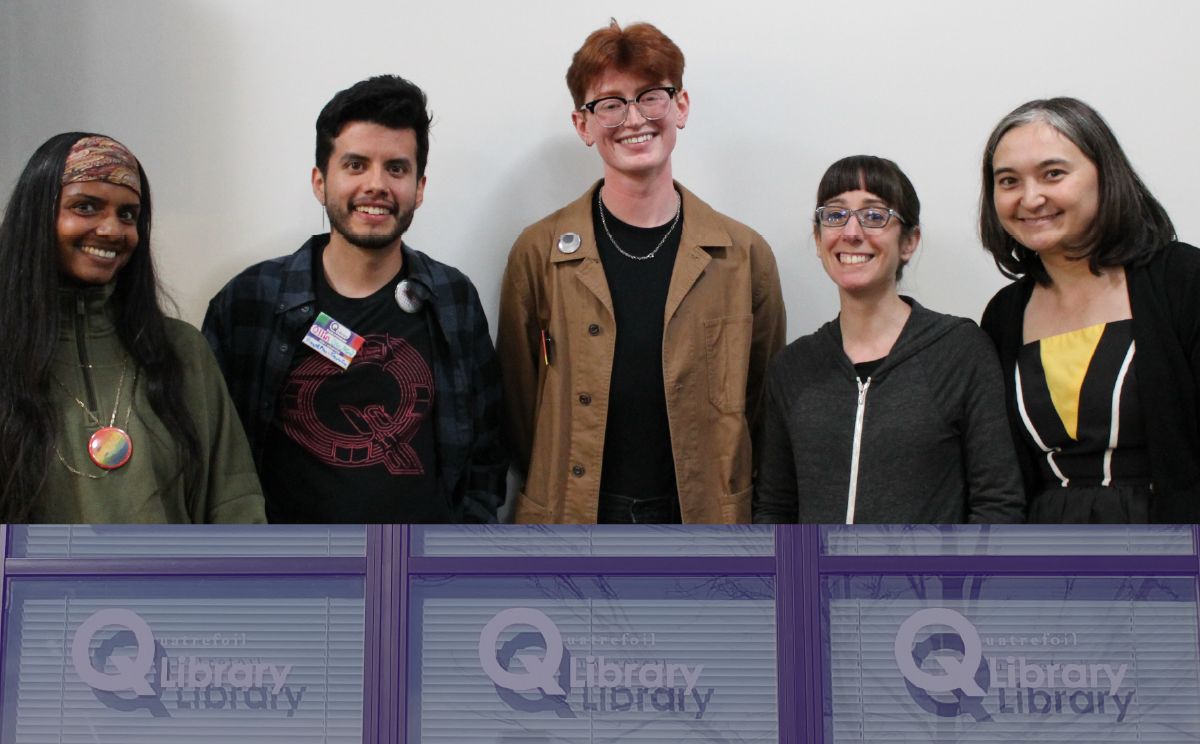
Forty years later, that collection has grown into an important community resource. Two of the people helping carry its story forward are Iggy Gehlen, chair of the library's programming committee, and Katie Hagen, library manager. In an email interview with Twin Cities Gay Scene, they talked about what's on the shelves, who's walking through the door and why this anniversary matters.
What's on the shelves
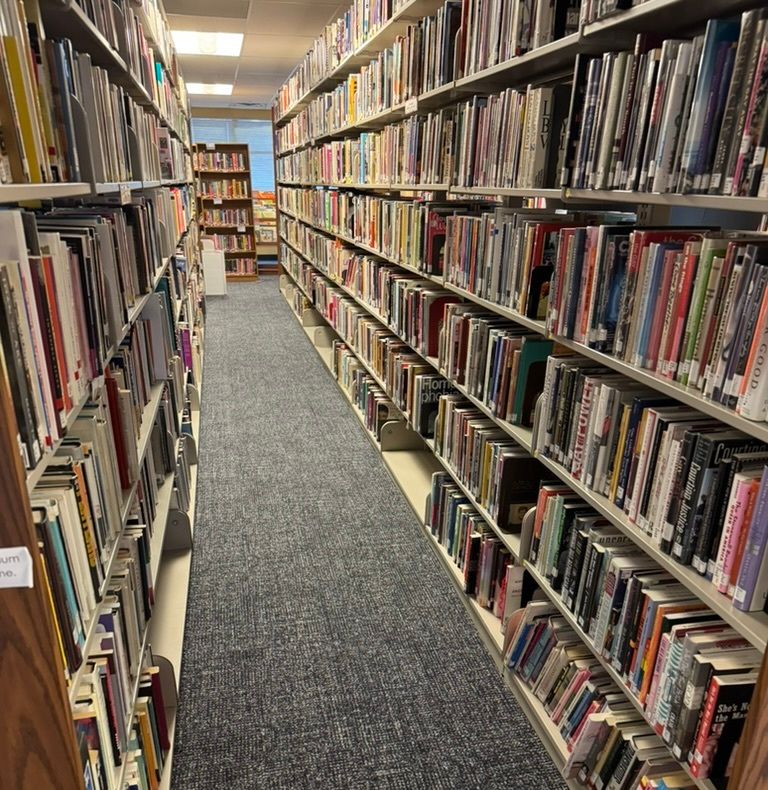
According to Gehlen and Hagen, the collection is entirely by, for and about the LGBTQIA+ community, and local people help curate it. It includes:
• Fiction and nonfiction
• DVDs and zines
• Erotica
• An extensive archive of queer reference materials, historical publications and local LGBTQIA+ periodicals
The archive includes newspapers, magazines and newsletters spanning 75 to 100 years of queer publishing, they wrote.
Among the treasures are Damron travel guides dating from the 1970s through the 1990s. These pocket-size directories listed gay-friendly clubs, hotels and bars at a time when that information often traveled by word of mouth. According to Gehlen and Hagen, the first edition appeared in 1964, a lesbian edition followed in the 1990s, and the final guide was published in 2019.
Membership is free. The library's Q Digital collection of e-books and audiobooks is available to members anywhere, something Gehlen and Hagen say can be especially important for people who need the discretion of a digital-only resource.
More than a place to borrow books
Quatrefoil is also a place to find your people. Events happen throughout the week, bringing together people with shared interests and creating opportunities to connect.
In one recent week, the schedule included Queer Threads, a fiber arts group; a Kink Accessibility Network monthly social; a volunteer potluck; and a Prime Timers book club and domino group.
The library welcomes thousands of visitors a year, from regulars to people just passing through. Gehlen and Hagen said Quatrefoil has increasingly become a landing spot for people moving to Minnesota from surrounding states and the American South.
For someone new to Minnesota, finding a place where queer history, resources and community come together can be a meaningful first step toward feeling at home.
Honoring the past, building the future
Forty years in, Quatrefoil is busier than ever. Gehlen and Hagen reported an unprecedented number of new members this year. More members also mean higher costs to maintain and expand the collection.
They also pointed to what they described as a politically backed effort to erase or hide LGBTQIA+ history. That makes a library that doesn't censor its collection and offers free membership all the more important.
"Quatrefoil isn't going anywhere," they wrote.
The anniversary is a chance to recognize the people who built the library and invest in the generations who will depend on it next. Gehlen and Hagen said support from the event will help Quatrefoil reach more people and give them the best experience possible.
Friday, Oct. 16:
Come celebrate Quatrefoil at 40
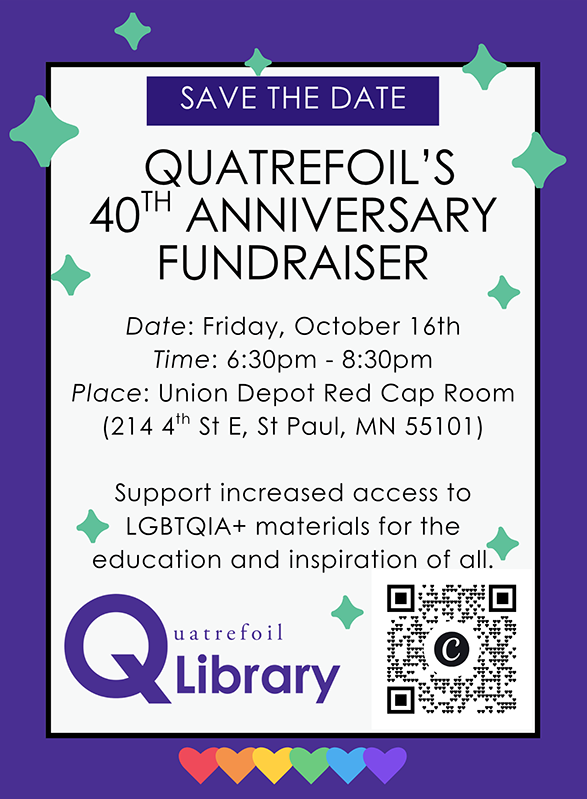
Quatrefoil invites everyone to its 40th anniversary fundraiser, a night to look back on four decades of community and get ready for what's next. Longtime supporters, current members and the curious are all welcome.
**When:**
Friday, Oct. 16, 6:30 to 8:30 p.m.
**Where:**
Red Cap Room, Union Depot, St. Paul
**What's planned:**
Silent auction, library memorabilia from past generations, music and time to mingle
**Program:**
Updates from the library's board president, vice president and librarians, with local drag queen Lala Luzious as emcee
Tickets are $75. Whether you've been borrowing books for decades or have never set foot in the library, your support helps carry Quatrefoil's mission forward.
The library has set a goal of raising $40,000 for its 40th year. Tickets, auction bids and donations all help. Can't make it? You can still give.
Why visit?
Gehlen and Hagen describe Quatrefoil as one of very few explicitly LGBTQIA+ libraries in the country. They also point out that the people volunteering there do it because they believe in the work.
Their invitation to first-time visitors is simple: Spend 10 minutes looking around. You're likely to find a new connection, a useful resource or a book you didn't know you needed.
And really, who couldn't use a little more of that?
*Twin Cities Gay Scene thanks Iggy Gehlen and Katie Hagen for their time.*

Money, but make it real: you saved it. Now you have to spend it.
There is something nobody tells you about retirement: eventually, you have to spend the money you spent all those years saving.
I'm only recently retired, and I'm discovering that this is a surprisingly weird mental adjustment.
When you're working, money comes in. You get a paycheck. You deposit it. You pay the bills. You save some. Then one day, the paycheck stops, and suddenly you're looking at the money you've accumulated and thinking: OK. Now what?
That was one of the things I wanted to ask Darla Kashian, Director and Financial Advisor with Kashian Karels Group at Baird Private Wealth. Her answer made me feel considerably less alone.
"The hardest day of your life was the day that you would have gotten paid but didn't get a paycheck," she told me.
Yep. Because now you have to figure out how to turn the money you've accumulated, a 401(k), pension, Social Security and other savings, into something that functions like a paycheck.
"Now you've got to spend the money you saved," Darla said, "and that's a hard mental thing to do."
No kidding.
Is there really a magic retirement number?
For years, we've heard versions of the same advice: You need a million dollars. You need 20 times your annual income. You need this number or that number before you can retire.
Darla isn't convinced there's one magic number that works for everyone. In theory, she said, you might hear that you should have 20 times your annual earnings. But that doesn't necessarily make sense for everyone. If you earn a million dollars but don't live like someone earning a million dollars, your retirement needs aren't necessarily the same as someone who spends every dollar they make.
Which brings us right back to the question from part one: what does your life actually cost?
That's a much more useful number to know than some arbitrary retirement finish line.
What about touching the principal?
This was one of those moments when I stopped her.
Darla had been talking about the old advice: "Don't touch the principal." We've heard it forever. Live off the interest. Live off the dividends. Preserve the nest egg.
But I asked: What does that actually mean?
Her answer surprised me. Eventually, she said, yes, you can spend the principal. If you're 88, are you really planning as though you might live another 20 years? Probably not. And retirement spending isn't necessarily one flat number for the rest of your life.
At 65 or 70, you might be traveling, going to restaurants and doing all the things you finally have time to do. Later, your spending may change. Instead of dinner out, maybe it's lunch. Instead of taking a cruise, maybe you're talking about the cruise you took at 70.
Darla says she routinely sees spending decrease in people's 80s, although health care and end-of-life expenses can change the picture.
So maybe the goal isn't to die with the biggest possible bank account. Maybe the goal is to have enough money to live your life.
Darla put it bluntly: "It's okay if you die broke. It's really bad if you're broke broke the day before you die."
That one made me laugh. And then it made me think.
What about family?
This is another place where good intentions can get us into trouble. And for queer people, "family" can mean a lot of different things.
Many queer people are parents. They may be helping adult children, paying for college, contributing to a first home or simply stepping in when their kids need help. That instinct to help doesn't necessarily disappear when you retire.
But not everyone has children. Some people have partners, siblings, nieces and nephews, aging parents or chosen family they love and support. Others may have very few people depending on them financially at all.
The point is not that you shouldn't help the people you love. It's that you need to know what you can realistically afford to give without putting your own retirement at risk.
Darla says she sees people in retirement who have overextended themselves financially helping their children, cosigning student loans, paying expenses they can't really afford, putting their own retirement security at risk.
Her advice is simple: "Your kids can borrow money to go to college. You can't borrow money to retire."
That's not selfish. That's planning.
nd maybe the broader lesson is this: Before you decide what you can give to the people you love, make sure you've figured out what you need to keep for yourself.
And then there's the market
If you've ever opened your retirement account during a market downturn and immediately thought, oh my God, get me out, you're not alone.
Darla says much of what she does with clients is helping them manage that anxiety. People get excited when markets are doing well. Then the market drops and they panic and sell.
"People have exuberance when the market is good," she said, "and then when the market has a correction, they panic and sell."
Her reminder is simple: buy low, sell high. Easier said than done when you're watching your retirement money disappear on a screen.
But Darla says patience matters. "If everything about money were just a math problem, I would not have a job," she said.
That may be my favorite explanation of financial advising. Because the math is one thing. We're the complicated part.
What I'm taking away as a new retiree
I'm learning that retirement isn't simply the day you stop working. It's the day you start thinking differently about money.
You are no longer asking: How much can I save? You're asking: How much can I safely spend?
For those of us entering retirement, Darla's advice is to start with the basics:
• Know what your life actually costs.
• Know what income you will have coming in.
• Understand Social Security and when you plan to claim it.
• Know what your pension provides, if you have one.
• Understand how you'll draw from retirement accounts.
• Don't make emotional investment decisions during market downturns.
• Don't sacrifice your retirement security to support the people you love.
• And remember: The money was saved for a reason. To live.
That last part might be the hardest lesson of all.
A quick note: This is part two of a three-part series on money. I'm writing it because, as a newly retired person myself, I think these are conversations worth having, even when they make us squirm a little. Darla's insight is genuinely helpful, but this isn't a substitute for your own financial professional. Consider it a nudge to start the conversation, not the final word.

Why We All Do Better When We All Do Better
“We all do better when we all do better.”
— Sen. Paul Wellstone
Sen. Paul Wellstone died on Oct. 25, 2002. I remember that date well. It was my 41st birthday, and friends from the newsroom were planning a rare birthday lunch. By late morning, our plans vanished as the tragedy became national news.
Our team at CONUS Communications quickly deployed a satellite newsgathering truck to the remote crash site, providing live video and updates to a grieving nation.
Today, I live in Northfield, Minnesota, after 25 years in my beloved Minneapolis. Wellstone was a treasured political science professor at Carleton College and launched his political career right here in this lively, two-college city.

A new chapter at Scene
So what does Wellstone’s legacy have to do with Scene — or even me?
Quite a bit.
Following my recent retirement from Mayo Clinic, I stepped into the role of Scene’s first managing editor. For 20 years, Twin Cities Gay Scene has told stories, shared events, celebrated people and helped our community find one another.
As Scene enters its third decade, Wellstone’s words resonate with me more than ever:
We all do better when we all do better.
Community matters
Our community is wonderfully diverse, creative, complicated and constantly evolving. There is no single way to be queer, and there shouldn’t be.
That’s why I believe we need to support the people, businesses, artists, organizations and community leaders who reflect the values we care about.
That support can be as simple as where we spend our money, which local businesses we recommend, whose art we see, which organizations we support and whose stories we share.
And yes, it includes supporting queer media.
For 20 years, Scene has been part of that community. We believe local queer media matters because our stories matter. They deserve to be told, celebrated and preserved.
What’s next for Scene
We’re growing.
We’re expanding coverage of the arts and culture that bring us together — theater, drag, music, books, film, food and travel. We’ll continue covering the events and people that make Minnesota’s queer community so vibrant.
We’re also expanding into the practical side of life: money, retirement, travel, resources and the everyday things that matter Monday through Friday, not just on the weekends.
And we’re looking beyond the Twin Cities, because queer Minnesotans live everywhere.
After 20 years, Scene is still here. We’re evolving, we’re growing and we’re excited about what’s next.
I’m lucky to be part of this next chapter.
And if Wellstone was right — that we all do better when we all do better — then let’s keep doing our part to make Minnesota’s queer community stronger, together.
Best,
Deb
*************************************************

Money, but make it real: what does your life actually cost?
Sex. Politics. Religion.
You're probably more likely to know where your friends stand on those personal topics than how much money they make or how much they've got tucked away for retirement.
Money makes us funny. And not in a ha-ha way. It makes us weird.
We don't talk about it. We compare ourselves to other people. We worry we're not doing enough. We feel guilty about what we spend. And sometimes we don't even want to look at the numbers.
I know this because I'm doing it myself. I'm a recent retiree who spent a lifetime working, saving, planning and thinking I understood money. And now I'm retired and thinking: OK. Now what?

So I called Darla Kashian, Director and Financial Advisor with Kashian Karels Group at Baird Private Wealth. She's also really good at taking something that can make your eyes glaze over (money) and making it feel manageable.
We talked about debt. Emergency savings. Retirement. And why the heck it's so hard for us to talk about money in the first place.
I came away with pages of notes. And a few things I can't stop thinking about.
First: forget the word "budget"
Darla has a problem with the word budget.
"Budget is a six-letter word," she told me.
And I laughed because I knew exactly what she meant. For a lot of us, budget sounds like diet. Restriction. Guilt. The financial version of someone standing over your shoulder saying, "You shouldn't be spending that."
Darla has a better question: what does your life cost?
How much actually lands in your bank account every month? What does your mortgage or rent cost? Utilities? Your car? Food? Entertainment? Debt?
And then the really interesting question: do the things you're spending money on match the things that are actually important to you?
"It's not about judgment. It's about understanding," Darla said.
That may be my favorite money advice so far. Because I don't need somebody telling me I'm "bad" with money. I need to know what's actually happening.
It's not about deprivation. It's about paying attention.
So where does the money go?
Darla has a pretty simple order of operations:
But I really liked what she said about the emergency fund.
We've all heard that we need three to six months of expenses saved. If you're starting with nothing, that advice can sound ridiculous. Where exactly am I supposed to find $30,000?
Darla's answer: make it smaller. Start with three months of your smallest bill. Your phone bill. Your electric bill. Whatever you can manage. Then check it off.
"Break it into a digestible, achievable list of goals," she said.
Digestible. I love that word because money advice can get very undigestible very quickly.
And then there's the emotional part
This may be the biggest thing I took away from our conversation. Money isn't just math. If it were, we'd all be millionaires, right? We attach so much to money. Success. Failure. Security. Independence. Even our sense of whether we're doing OK in life.
Darla doesn't pretend the emotion isn't there.
"If I pull cash out of my pocket, people have an emotional reaction to that," she said. "If I pull a wad of Kleenex out of my pocket, people wonder if it's been used, but they don't have the same emotional reaction."
Exactly. We're emotional people. So maybe the goal isn't to get rid of the emotion. It's to understand it.
Your money homework
I'm not suggesting you spend your weekend creating a 42-tab spreadsheet. Please don't.
Instead, this month:
You don't have to fix everything. You just have to start looking. As Darla said, the goal isn't judgment. It's understanding.
And maybe that's the first step toward making money a little less weird.
Darla and I had a lot more to talk about, so next up: spending.
A quick note: This is part one of a three-part series on money. I'm writing it because, as a newly retired person myself, I think these are conversations worth having, even when they make us squirm a little. Darla's insight is genuinely helpful, but this isn't a substitute for your own financial professional. Consider it a nudge to start the conversation, not the final word.
*************************************************
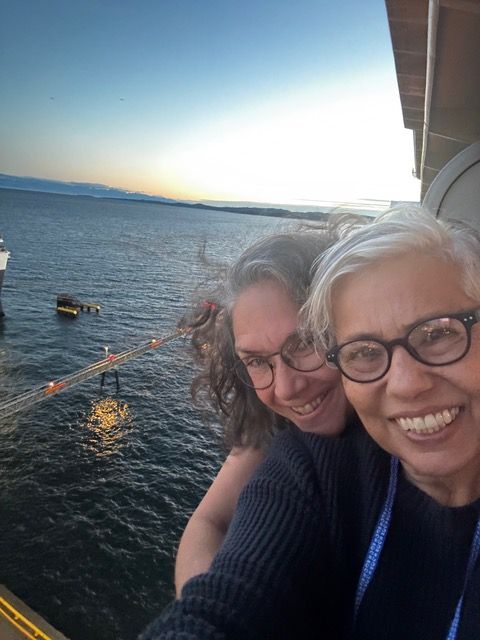
The view from the balcony: Two older lesbians cruise Alaska
It’s taken 50 years of working to get to this article. I retired. At age 64. My first Social Security withholding shows I made $284 in 1976. I think I was delivering newspapers on my beat-up bike. I’ve done a little better since then and decided to reward myself, and my wife and partner of 26 years, with a cruise to Alaska. We invited my sister and her husband.
I have discovered I have reached the age where strangers look through me instead of at me. Unless I'm holding my wife’s hand, or calling out to her from across the room. Or sharing a king-sized bed in our stateroom cabin with a balcony.
I’m also 5’2” though I’d never know it unless I’m surrounded by 3,600 other travelers on an Alaskan cruise.
We are lucky. Two of our favorite gay men are well-traveled and introduced us to the world of cruising back when I was about to turn 50. I felt 35. We traveled with 1700 gay men and were two of about 20 women aboard the Nieuw Amsterdam for a whirlwind Mediterranean cruise. That’s another story, but one that set our expectations pretty high. These two gentlemen have sailed the Royal Princess and gave great tips. It’s nice to have boyfriends.
Heading to Seattle
We flew from the Twin Cities to Seattle, where we met our traveling companions. We shared a Jack-and-Jill room downtown, wandered Pike Place Market, had a meal and a cocktail, and prepared to board at noon the following day.
Set to sail
We headed to the buffet while we waited for our luggage. It was fine. But what finer was the view. Water. Mountains. Blue skies.
Our balcony room, A622, was on the 12th floor - conveniently directly across the hall from the laundry. We’ll get back there. The room was spacious, the thick white duvet deliriously comfortable. But the view was the reason we took this trip: two chairs, a little table, mountains, water, sky.
Ports of interest
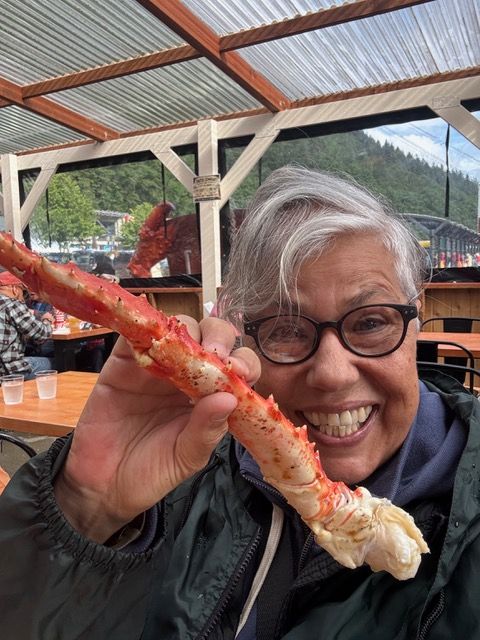
Juneau - Off ship, took a tour of a mine and panned for gold, ate the most expensive crab leg ever at Tracy’s. Didn’t see anyone who looked like us. (Did I mention I’m 5’2” and my wife is 5’11”?)
Skagway - Off ship, took a small bus tour to the Klondike summit, bordering Canada. Our tour guide, Tibitha, was a purple-haired thirty-something and we hugged. She acknowledged us. It was one of our favorite excursions.
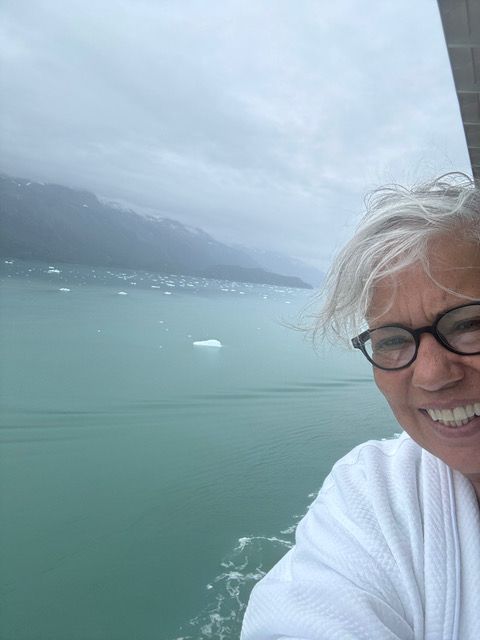
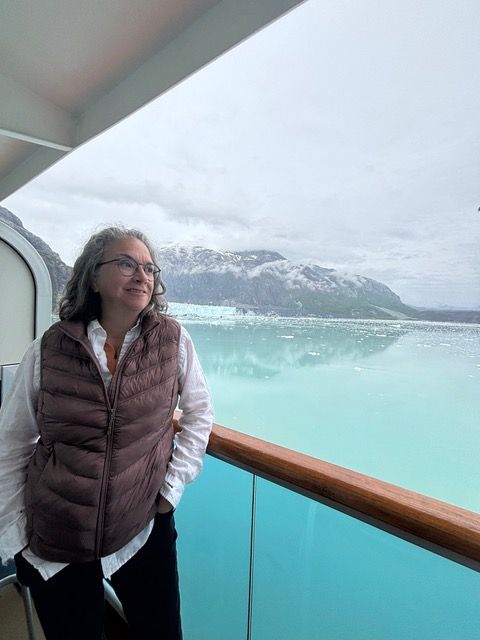
Glacier Bay National Park - Ship day. The day my wife, Barbara, and I most enjoyed together: on the balcony, with duvets on our laps, binoculars in hand, a sense of serenity.
I noticed what I thought were lots of little dark logs floating by until I realized, with the help of my binoculars, that these were actually sea otters swimming on their backs. Dozens of them. Some with babies on their bellies. That was amazing. As were the eagles on the icebergs. We witnessed a “calving” on the Margerie Glacier. That’s when a large chunk of ice breaks off the face of a glacier and crashes into the water. It was a breathtaking moment.
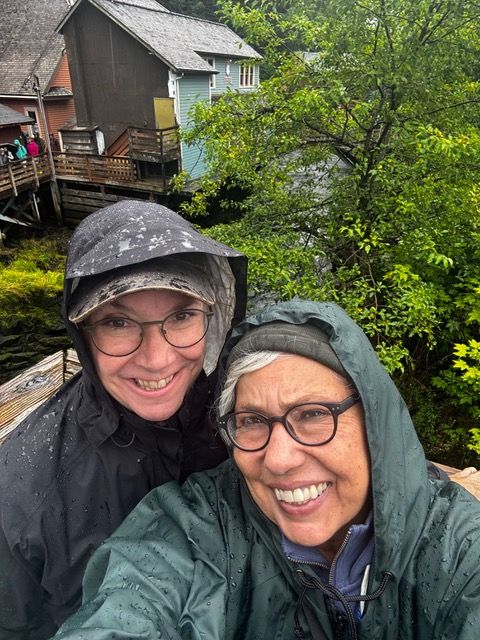
Ketchikan - Off ship. This is the salmon capital. And it was perhaps the hardest stop for me. Thousands of people crammed on narrow streets, all vying for views of the seals and sea otters in the water. We did see some Pride flags displayed in various shops about town, and while that was thrilling, I thought I was going to be beaten up by a fellow on a bridge. I’m short, it was raining, and we were all trying to see the sea creatures along Creek Street. I tried to wedge myself, sideways, between two very tall, large men who had their elbows spread out. The more I tried, the harder they pushed into me. This wasn’t a mosh pit at First Avenue, though it sure felt like it.
“Hey, I’m standing sideways; can we share here? Maybe be GOOD AMERICANS?
This is when I thought I was going to get punched. He swung around ready to go. “Don’t even start,” he yelled.
The rain pushed down hard on my face and glasses, and I walked away.
“Sure, leave NOW,” he followed.
My little sister shows up, says something to him, and we move along.
This is when I realized: I’m old. I’m short. I’m not considered. I find my wife.
I liked this stop the least. Not because it wasn’t beautiful or welcoming, but because the wet, cold crowds seemed to slosh through the streets, umbrellas in hand, seeing everything and noticing nothing.
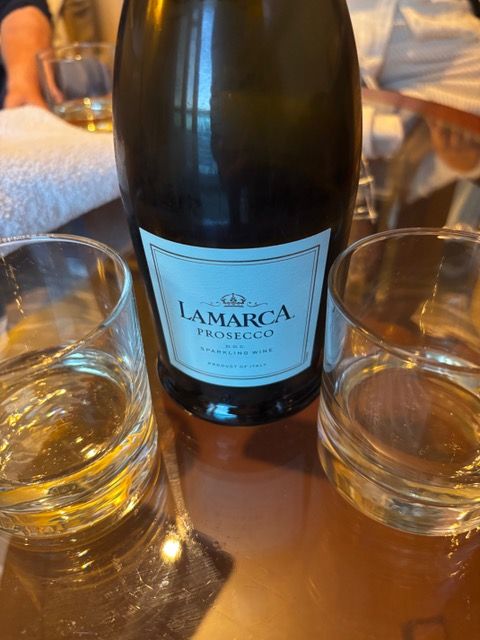
Victoria, Canada - We stayed aboard, sipped Prosecco from my sister’s mini-suite and watched the pier below. I quietly apologized to my brother’s and sister’s in Canada for the cruelty of our current administration.
Aboard the Princess
The nod. I was an active participant, offering my own nod of acknowledgment though I never did make true contact. My gaydar went off often, offering the silent nod of recognition to other older dykes aboard. We saw older gentlemen dining together in matching outfits, perfectly coiffed, and smiled.
Was it hard to be an older lesbian aboard a cruise ship that was a little this and a lot of that? From couples in their 80s to families with kids and then us. Not really. We nodded and smiled and treated each other with warmth. After 26 years together, Barbara and I still know how to find each other.
Would we do this again? Sure. Would we rather have a ship full of queers? Sure. What mattered most was we felt safe and welcomed by the staff and our steward.
Maybe getting older means fewer people notice you. But the people who do notice you recognize exactly who you are.
BalzerTalk – What’s Next with Deb
After a career spanning television news, marketing, public relations, and medical communications, Deb Balzer is embracing her next chapter with curiosity, enthusiasm, and a sense of adventure.
A longtime supporter of SCENE, Deb came out as a teenager in 1978 in a small town in western New York. She spent 25 years in the Twin Cities before making Northfield, Minnesota, home, where she lives with her wife and their dog. In 2020, she helped co-found Northfield’s first Pride in the Park.
A traveler, music lover, food fanatic, and Minnesotan by choice, Deb shares queer-friendly happenings, hidden gems, great eats, memorable adventures, and the fun of figuring out what’s next around the Twin Cities and beyond. What’s on your list?
Follow Deb on social media @BalzerTalk.
We need your consent to load the translations
We use a third-party service to translate the website content that may collect data about your activity. Please review the details in the privacy policy and accept the service to view the translations.